Quite simply, the best cultural review in the world
FeaturesIt is no use pretending that Kiplings view of life, as a whole, can be
accepted or even forgiven by any civilized person.
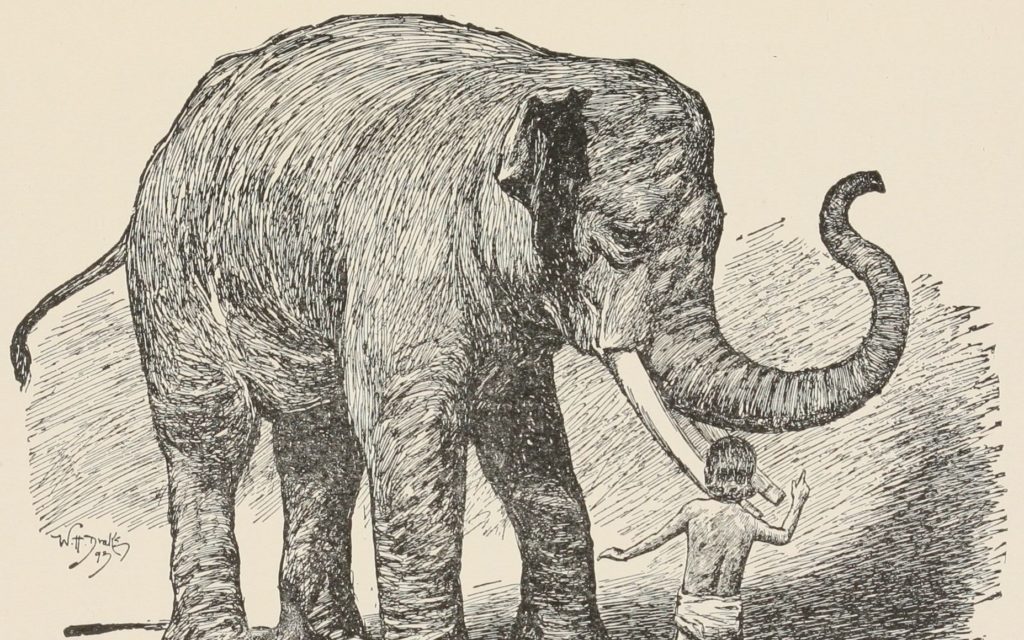
My childhood home did not boast many literary accoutrements. Apart from an imposing set of Worlds Classics, what I chiefly remember is a framed copy of (Joseph) Rudyard Kiplings poem If. It was printed with impressive gilt filigree on a sheet of foolscap and, together with a portrait of my Guardian Angel, it presided in quiet admonition on my bedroom wall. I never memorized the poem, though I internalized its cadence while nervously savoring the impossible combination of virtues it pleaded: If you can keep your head when all about youEtc. Tough for an impatient eight- or ten- (or fifty-) year-old. There were thirteen such conditionals to be fulfilled before arriving at the consummating apodosis: Yours is the Earth and everything thats in it,/ Andwhich is moreyoull be a Man my son! All well and good, I remember musing, but what if not? If is probably Kiplings most famous poem. As recently as 1995, a BBC poll named it Britains favorite. Written in 1895, when Kipling was thirty and crossing the threshold to international celebrity, it was published as part of Rewards and Fairies, a set of historical stories, in 1910, when his reputation was already on the wane. In a celebrated essay on Kipling from 1942, George Orwell dismissed the poem as the sort of thing (about the only sort of thing) Colonel Blimp would like. Today, I suspect, Kipling is regarded chiefly as that most anodyne of literary practitioners: a childrens author, creator of the boy Mowgli, Kaa the python, and Shere Khan the Tiger, the genial-looking, pipe-puffing genius who wrote Kim and populated the imaginations of boys and girls with the sultry weather of the Raj, explained how the elephant got its trunk, and decorated it all with fastidious (little) poems that rhymed and scanned. Kipling was picturesque. He was born in romantic-sounding Bombay, and he got his precocious literary start in India after a decade of schooling in England. (His parents chose Rudyard, by the way, after a lake in Staffordshire where they courted.) If his stories are exotic, even scary at times, they are nonetheless wholesome or at least susceptible to Disneyfication. How different it once was. Around the turn of the last century, at the apogee of Kiplings fame, Mark Twain wrote that he was the only living person not head of a nation, whose voice is heard around the world the moment it drops a remark, the only such voice in existence that does not go by slow ship and rail but always travels first-class by cable. In Kipling, the zeitgeist briefly found its impresario. For a time, his authority was as much political as literary. Kipling gave speeches advocating British supremacy in India and South Africa. He opposed the suffragettes and home rule for Ireland. He could be downright strident. It was Kipling, one of his biographers speculates, who popularized the metonymy Huns (actually, he insisted on huns with a small h) for Germans, a subject on which he grew increasingly ferocious. By 1915, Kipling was insisting that there were only two divisions in the world human beings and Germans. Kipling consistently refused state honors (a knighthood, the Order of Merit, the post of poet laureate) but by the late 1890s he was the undisputed if unofficial laureatebut also, which is sometimes forgotten, the Jeremiahof Imperial Britain. True, Kiplings celebrity was never universally applauded. Most literary folk instinctively disliked him. Henry James gave away the bride at Kiplings wedding, but he could be magisterially tart about Kipling the writer: great talent, he wrote in a letter of 1897, but almost nothing civilized save steam and patriotism. Oscar Wilde described Kipling as our first authority on the second-rate, a genius who drops his aspirates. And for Wildes disciple Max Beerbohm, Kipling always exercised the fascination of abomination: he was the man in whom the schoolboy, the bounder, and the brute found brilliant expression. This was, Ive always felt, a bit stingy of Max, who ought to have harbored some gratitude to Kipling for providing him such valuable fodder for his own caricatures and parodies. Particularly choice is P.C. , X, 36, in which a Kiplingesque constable collars Santa Claus emerging from a chimney on Christmas Eve: Wot wos yer doin hup there? asked Judlip, tightening the grip. For his part, Kipling cordially returned the animus, writing about the brittle intellectuals,/ Who crack beneath the strain (The Holy War) and the flanneled fools at the wicket(The Islanders). In 1889, shortly after returning to London from his apprenticeship in India, Kipling published In Partibus in (note the venue) the Civil and Military Gazette: But I consort with long-haired-things,Kipling was pals with H. Rider Haggard. Arthur Conan Doyle came to visit and give Kipling a golf lesson when he was ensconced with his American wife in Brattleboro, Vermont, in the early 1890s. But by and large, he consorted with politicians, generals, and magnates. George V was a close friend, so were Cecil Rhodes and Viscount Milner. When he won the Nobel Prize in 1907the first English-language laureate, and still the youngestthe citation mentioned not only his power of observation and originality of imagination but also his virility of ideas. By then, in the aftermath of the Boer War, the virility of Kiplings ideas was already a stumbling block; by the time the First World War was overa war that Kipling had foretold with uncanny accuracy and in which he lost his only son, Johnthe nation was in wholesale retreat from Kiplingesque virility. (Today, of course, it is unimaginable that a Nobel citationor most any other, for that matterwould commend someone for his virility of ideas.) When Kipling died, in January 1936, age 71, his pallbearers included the Prime Minister, an Admiral, a General, various other friends, but no literary figures. It would be instructive to trace the process that de-clawed and domesticated Rudyard Kipling, that gradually diminished that brusque and imposing giant to an entertaining homunculus. When the zeitgeist shifted, Kiplings politics suddenly became a popular as well as an elite embarrassment. (Poetry, T. S. Eliot, noted, is condemned as political when we disagree with the politics.) Typical was Orwells savage outburst: Kipling is a jingo imperialist, he is morally insensitive and aesthetically disgusting. It got to the point where people who had absorbed Kipling unwittingly suppressed his authorship. Orwell notes that Middleton Murry, quoting Kiplings famous lines There are nine and sixty ways/ Of constructing tribal lays, mistakenly attributed them to Thackeray. Kipling might have written good poetry, but it wasnt good for poetry to have been written by Kipling. Sanitizing Kipling, segregating his political and social opinions from his literary accomplishment, has had the unfortunate effect of diminishing the appreciation or even the knowledge of that accomplishment. A slim but representative selection of his poems in the attractive Everyman series offers a welcome occasion to return to that unfairly diminished master.[1] In 1941, T. S. Eliot edited and wrote an introduction for a plump collection of Kiplings poems. It was partly, but only partly, an effort at rehabilitation. Eliot noted Kiplings uncanny second sight, his seeming ability to lift and peer beneath the curtain of history, also his habit of writing transparently, so that our attention is directed to the object and not the medium. He spoke warmly of Kiplings consummate gift of word, phrase, and rhythm and praised his technical mastery: no writer has ever cared for the craft of words more than Kipling. Kiplings prosody was generally so regular that it is easy to miss the subtlety of his music and rhythmical variation. Eliot singles out Danny Deever, a typical Kipling soldiers poem from Barrack-Room Ballads (1892), that tells the story of the hanging of the eponymous Danny who shot a comrade sleepin. The poem begins in matutinal confusionthe bugles are blowing, but why? Eliot points out how Kipling insinuates a dread sense of acceleration and tautening step-step-step focus: Whats that so black agin the sun?Eliot is all admiration for the seemingly effortless prosodic mastery Kipling displays. But (and it is a large but) his essay turns on a distinction between verseat which Kipling is said to exceland poetry, which, says Eliot, he approaches but rarely and then only by accident. In other words, Kipling, though good at what he does, isnt really playing in the big league. Eliot doesnt put it like that, not quite. He even notes that Kipling is so different from other poets that the lazy critic is tempted merely to assert that he is not a poet at all and leave it at that. Eliot forbears to make that assertion. He nonetheless manages to leave it echoing in the readers mind. His essay is sensitive, intelligent, and a subtle masterpiece of deflation. The deflation operates primarily by apophasis. Eliot notes that one is usually called upon to defend modern poetry from the charge of excessive obscurity: with Kipling the culprit is excessive lucidity. Similarly, where one hears of complaints about the metrical chaos of modern poetry, Kipling is so regular he can be accused of writing jingles. Much modern poetry seems caught up in a sort of cosmic privateness: Kipling, who starts with the motive of the ballad-maker, seems all too involved with the events of the day. In short, Eliot wants to preserve a place for Kipling, but he also wants to put him in his placenot, we are meant to understand, the same (and higher) place occupied by Eliot himself. A good deal of intelligent commentary on Kipling operates like this. Irving Howe, for example, in his introduction to the Viking Portable Kipling, begins with the obligatory condemnation of Kipling the tub-thumper for imperialism, etc., but then proceeds to find numerous things to praise. His denouement is the conclusion that Kipling was a brilliant if unacknowledged fellow traveller of literary modernism. This strikes me as completely wrong. Kipling was in a different game altogether. Yes, he was sui generis, but only in the wayor rather, to the extentthat Eliot himself or other strong voice poets (Wallace Stevens, for example) are sui generis. You cant imagine Kipling beginning a long poem with the observation that April is the cruellest month (to say nothing of Complacencies of the peignoir). But then you cant imagine Eliot or Stevens writing Now this is the Law of the Jungleas old and as true as the sky;/ And the Wolf that shall keep it may prosper, but the Wolf that shall break it must die. Which is better, more important, more serious? I am not sure those are answerable questions. But if Auden is correct in defining poetry as memorable speech, what Kipling wrote is surely poetry. Orwell lists several phrases that have entered the language: East is East, West is West.To which we might add (to show that Kipling had a sense of humor) A woman is only a woman, but a good cigar is a smoke. Writing about Auden, Edward Mendelson distinguished between the vatic and civil traditions in poetry. The former aspires to the splendid isolation of aesthetic autonomy, the latter to a more public vocation: poets, says Mendelson, who write as citizens, whose purpose is to entertain and instruct, and who choose subjects that would interest an audience even if a poet were not there to transform them into art. That, I believe, brings us to the neighborhood where Kipling flourished. Although possessed of prodigious gifts of verbal and rhythmic invention, Kipling sought not the lyric moment but a more didactic end. I know that didactic is not what Stephen Potter would call an O.K. word these days. We resist the presumption that art should aspire to teach almost as much as we resist the idea that we might be in need of tutelage. It is worth noting, then, that Kiplings didactic designs were, at least in part, capacious. As has often been pointed out, in much of his work, he sought to give memorable voice to segments of society (even of animal society) hitherto lost in inarticulacy: the Indian beggar, the uneducated solider, the hard-bitten colonial administrator. Kipling was especially good at capturing the sweaty rage of pride affronted, as here, in Tommy: Yes, makin mock o uniforms that guard you while you sleepI have always greatly admired Tommy, not least for is psychological acuity. The good citizens of Berkeley, California, would profit from taking its message to heart. They might also get outside The Gods of the Copybook Headings, a poem that is full of sage but perpetually forgotten advice: They swore, if we gave them our weapons, that the wars of the tribes would cease. But Kipling was not all barracks-room bluster or overt moralizing. Far from it. As Robert Conquest notes in his excellent Note on Kiplings Verse, if Kiplings was a poetry of clarification rather than of subtlety and suggestion, you could also easily make a selection of his poems that would show him to be a poet of sensitivity and sorrow. The Way Through the Woods, a haunting, Hardyesque lyric, reveals another, less declamatory side of Kipling: They shut the road through the woods In fact, Kipling was a poet of considerable emotional range and conspicuous majesty. Recessional, the poem that catapulted Kipling from mere fame to nationwide celebrity, was written in 1897 for Victorias Diamond Jubilee. It is an ever-pertinent masterpiece about hubris and the evanescence of power. Instinct with Biblical echoes, it issues a lofty call to humility and awe; it also contains one of the two most politically incorrect lines in all of Kipling: If, drunk with sight of power, we looseAs Orwell noted, the line about lesser breeds is always good for a snigger in pansy-left circles. But it doesnt refer, as Orwell also noted, to coolies being kicked about by pukka sahib in a pith helmet but rather to the awe-less multitudes without the Law, Germans, first of all, but also anyone who glorified power without restraint or obeisance. (The other gem of political incorrectitude, for the record, is the white mans burden, title and recurrent phrase of another famous poem: Take up the White Mans burden/ And reap his old reward:/ The blame of those ye better,/ The hate of those ye guard. How we squirm at that today! But as David Gilmour points out in The Long Recessional: The Imperial Life of Rudyard Kipling, the word white plainly refers to civilization and character more than to the colour of mens skins. The white men are those who conduct themselves within the Law for the good of others: Gunga Din may have a dirty hide, but he is white, clear white, inside. The key word is civilization. Kipling was above all the laureate not of Empire, but of civilization, especially civilization under siege. Henry James once sniffed that there was only one strain absent in Kipling: that of the civilized man. Its a frequent refrain. But in a deeper sense, Kipling was about almost nothing elsenot the civilization of elegant drawing rooms, but something more primeval and without which those drawing rooms would soon be smashed and occupied by weeds. Kipling, Evelyn Waugh wrote toward the end of his life, believed civilization to be something laboriously achieved which was only precariously defended. He wanted to see the defenses fully manned and he hated the liberals because he thought them gullible and feeble, believing in the easy perfectibility of man and ready to abandon the work of centuries for sentimental qualms. Kipling endeavored to man those defenses partly through his political oratory, but more importantly through a literary corpus that taught the explicit lessons and the implicit rhythms of emotional continence and restraint.
Notes
This article originally appeared in The New Criterion, Volume 26 April 2008, on page 22 Copyright © 2008 The New Criterion | www.newcriterion.com http://www.newcriterion.com/articles.cfm/rudyard-kipling-unburdened-3806
rate this article
E-mail to friend
|
Already a print subscriber? click for online access
On the sadness of higher education
On comparing the university life then with now.
The world we have lost: a parable on the academy
On the Alexander Hamilton Center affair at Hamilton College.
Introduction: What was a liberal education?
An introduction to our special issue on education.
An introduction to our symposium on the future of conservatism in Britain and America.
"Openness" & "The Closing of the American Mind"
On the role of ideas of "tolerance" in the intellectual decline.
June 04 2008
OPEN EVENT: 2008 Bradley Symposium: Encounter at 10
October 22 2008
GALA EVENT: The New Criterion Benefit Art Auction
January 25 2009
TRAVEL EVENT: The New Criterion Cruise
add a comment
you must be a new criterion subscriber to post a comment. {subscribe now}