Sign in  |  Register

The New Criterion

Quite simply, the best cultural review in the world
- John O’Sullivan
Subscribe Now and get unlimited access

Books

October 1996

Shorter notice

by Robert Richman

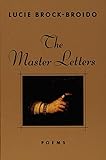
Review of The Master Letters by Lucie Brock-Broido

The Master Letters opens with “Carrowmore,” a decorous, restrained lyric about a girl finding an ornament and a piece of hair—two offerings, she surmises, to a dead predecessor—in the earth:


She buried her bone barrette


In the ground’s woolly shaft.
A tear of her hair, an old gift


To the burnt other who went
First. My thick braid, my ornament—


My belonging I
Remember how cold I will be.

In terms of style, however, “Carrowmore” is not an augur of things to come in this book-long tribute to Emily Dickinson. Many of Brock-Broido’s poems—her title comes from three letters Dickinson left in her drawer at her death, one addressed to “Recipient Unknown” and two to “Master”—are composed in a sinewy, ornate language that recalls Gerard Manley Hopkins more than Dickinson:


That I had no idea I had been travelling
In the scrying light, crutched friar roaming


Snow-apple orchards every autumn,
Clutching the fireless stricken lantern


Of your feudal dark …

Brock-Broido’s modern-day verse epistles are addressed not to one particular “Master,” but to men in general; some express anguish and anger, others an amusing obsequiousness spoken in a mock-groveling tone. Occasionally there is a note of defiance: “I am … nobody’s panther … nobody’s violin … nobody’s isotope … nobody’s humming bird.” And yet, Brock-Broido’s sequence isn’t feminist; it’s too ambivalent, unpredictable, and rifled with self-doubt for that. In “Grimoire,” a poem near the end, Brock-Broido announces that her “little book of incantation” (i.e., her volume of poems) will soon “be done,” but “is nothing that I want.” And in the “letter” to the poet’s dead father, also late in the sequence, the book’s high point in language coincides with the poet’s own “surrender”— the word is from this poem’s title, “The Sleeping Hollow of His Face Will Be the Straight Pass of Surrendering”—to less “blister & audacity” on her part and to a balanced view of men:
                                                                                             

             And from that

Tourneying, that day,
There would be nothing


More to crave & nothing
More to set the heart on,

No cumulus of knowing,
No rubricant of pulse.

(Aptly, this is the first time any form of the word surrender appears since the insubordinate “not surrendering” remark in a poem earlier in the book.) Also dulling any potential political edge is the quantity of quotes interpolated in the text—from John Clare, Robert E. Hayden, Archibald MacLeish, and Anna Akhmatova, to name a few. (One is tempted to say that Brock-Broido digs into the literary past much the way the barrette-finding girl of “Carrowmore” digs into the earth, and the poet’s interest in parents, precursors, and ancestors isn’t overcome until the last poem, a celebration of now-ness in which the word am turns up twelve times.) Distancing the book even further from any kind of diminishing political orthodoxy, however, is the baroque writing, which is as far from a Williamsian “natural” speech (not to mention a Williamsian focus on the present) as can be imagined. “What lives of subject matter, dies of subject matter. What lives in language, lives by language”: Karl Kraus’s observation comes to mind when reading Lucie Brock-Broido’s new book of poems.

Difficult, steeped unashamedly in language and the literary past, The Master Letters is a blow to the recent resurgence of a populist, vernacular poetry.

Robert Richman


more from this author

This article originally appeared in The New Criterion, Volume 15 October 1996, on page 72

Copyright © 2009 The New Criterion | www.newcriterion.com

http://www.newcriterion.com/articles.cfm/Shorter-notice-3476
rate this article for your user profile

E-mail to friend

add a comment

Name:
Email:
Website:
Verification:

The New Criterion

By the author

Prosody atrocities

by Robert Richman

Review of All the Fun's in How You Say a Thing: An Explanation of Meter and Versification by Timothy Steele

Edwin Muir's journey

by Robert Richman

On the Scottish poet & his work

George Mackay Brown, 1921-1996

by Robert Richman

On the life & work of the Scottish poet

You might also enjoy

Most popular

view more >

download
first delivery

The New Criterion is now optimized for Mobile Devices

New from The New Criterion:
40 page special issue
on our conference

"Free speech in
an age of Jihad"

Events

November 09 2009

YOUNG FRIENDS: Tour of an important contemporary art collection


November 24 2009

OPEN EVENT: Laura Jacobs reading


December 02 2009

Friends Event: The Swallow Anthology Reading

Webcasts

New Criterion-Social Affairs Unit Conference: Part 4
"The Criminalization of Making Money" by Lionel Shriver, Recorded 9/25/09


New Criterion-Social Affairs Unit Conference: Part 3
"The State and the Threat to Democracy" by Jeremy Black and "The Paradox of the Intellectual and the Future of Capitalism" by Tim Congdon, Recorded on 9/25/2009


New Criterion-Social Affairs Unit Conference: Part 2
"Nice 'N' Easy: The Age of Micro Tyranny" by Mark Steyn, Recorded on 9/25/2009

Weblog