Sign in  |  Register

The New Criterion

It operates as a refuge for a civilizing element in short supply in contemporary America: honest criticism
- The Wall Street Journal

Books

November 2007

Shorter notice

by Callie Siskel

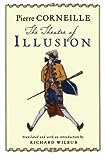
A review of The Theatre of Illusion by Pierre Corneille,Richard Wilbur

On The Theatre of Illusion by Pierre Corneille, translated by Richard Wilbur.

Pierre Corneille
The Theatre of Illusion, translated
and with an introduction
by Richard Wilbur.
Harvest, 144 pages, $12

The poet and translator Richard Wilbur brings the same integrity and ingenuity to his newest translation, The Theatre of Illusion by Pierre Corneille, as to his earlier esteemed translations of Molière and Racine. As with his previous translations, Wilbur skillfully preserves the rhymed couplets of the original, deftly substituting English pentameters for the original alexandrines.

The play is the story of a runaway lord, Clindor, whose spirit is summoned by a magician to appease his father. Pridament watches as the son, fighting for the love of the princess Isabelle, is killed, only to be told that the vision is actually a play, and the actor is his son, alive and well. Rich in wit and enigma, the spirit of the play is reminiscent of Wilbur’s own verse, which, in poems such as “The Mind-Reader,” renders the mysterious in expertly turned lines and striking images. Wilbur works to maintain the spirit of the original, writing in the introduction that “Tone … is the crucial thing in all translation.” By “tone,” Wilbur means feeling or mood, but as the translation shows he is also interested in capturing Corneille’s quality of sound.

One gets a sense of Wilbur’s tonal fidelity, to take just one example, in a line spoken by a boastful suitor, Matamore, who brags: “My wrath against these rulers needs engage/ Only a piddling portion of my rage.” Wilbur’s “piddling portion” maintains both the sense of spite and the alliterative chime of the original: “la moitié de ses moindres fureurs.” Yet Wilbur is unafraid to enliven Corneille’s diction where needed. In her bold monologue, Isabelle declares, “I’ll dog your footsteps in the dark of night/ Present a thousand horrors to your sight.” Wilbur brilliantly uses the verb “dog,” where Corneille uses “s’attacher,” a more literal version of “to follow.”
Wilbur’s ability to both strengthen and protect the original is beautifully exemplified by these lines spoken of Matamore: “For if they dared attack, I’d rather die/ Than soil this arm by fighting such canaille.” A look at the French shows how Wilbur reorders the first line to preserve “canaille,” a word that is used in both French and English: “Car j’aime mieux mourir que leur donner bataille,/ Et profaner mon bras contre cette canaille.” He inverts the structure of Corneille’s first line, ending his with “mourir” (“to die”) in order to make the rhyme. Wilbur is so seamlessly in step with Corneille that his version adheres to both the sense and sound of the original. Even his planned departures are inspired.

Callie Siskel is a former associate editor of The New Criterion.


more from this author

This article originally appeared in The New Criterion, Volume 26 November 2007, on page 92

Copyright © 2012 The New Criterion | www.newcriterion.com

http://www.newcriterion.com/articles.cfm/Shorter-notice-3696
rate this article for your user profile

E-mail to friend

add a comment

Leave this field empty
Name:
Email:
Website:
Verification:

The New Criterion

By the author

You might also enjoy

Most popular

view more >

The New Criterion is now optimized for Mobile Devices

Webcasts

Anthony Daniels on the Euro Crisis
The New Criterion author Anthony Daniels delivers remarks in New York City about the "European experiment." With an introduction by editor Roger Kimball. Recorded on November 30, 2011.


Andrew C. McCarthy: The Muslim Threat
The New Criterion contributor Andrew C. McCarthy delivers remarks in Effingham, Illinois, about the threat of Islamism to the United States. A Friend of The New Criterion, Dwight Erskine, introduces McCarthy to the Effingham audience. Recorded on October 1, 2011.


Roger Kimball: The Grim Future of Statism
The New Criterion editor Roger Kimball delivers remarks in Effingham, Illinois, about the future of statism and The New Criterion's 30th anniversary. A Friend of The New Criterion, Dwight Erskine, introduces Roger Kimball to the Effingham audience. Recorded on October 1, 2011.