Sign in  |  Register

The New Criterion

America’s leading review of the arts and intellectual life
- Harry Mount, the London Telegraph

Books

September 2010

Shorter notice

by Samuel Goldman

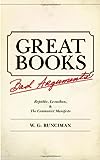
A review of Great Books, Bad Arguments: "Republic", "Leviathan", and "The Communist Manifesto" by W. G. Runciman

What makes a book great? When it comes to political philosophy, the answer involves some combination of compelling arguments, vivid accounts of political phenomena, and insight into the motives of citizens and statesmen. So what if a work of political philosophy features invalid reasoning, fantastic descriptions, and implausible psychology? Such a book, presumably, can be ignored by all but the most devoted scholars.

But suppose that book has been regarded as great for centuries. In that case, it would seem necessary either to lower the bar or to reject the judgment of the ages. Neither alternative is appealing. In Great Books, Bad Arguments, W. G. Runciman—a Darwinian sociologist, longtime professor at the University of Cambridge, and the third Viscount of Doxford—addresses himself to this dilemma. He proposes Plato’s Republic, Hobbes’s Leviathan, and Marx’s Communist Manifesto as cases in point.

According to Runciman, all three try to answer the question: “Can internal social conflicts be prevented?” While he approves the question, Runciman finds their responses profoundly unsatisfactory. One problem is that these authors just didn’t know as much as modern social scientists. In particular, they were ignorant of the fact that social order can arise from unplanned interactions and be sustained by oppositions of interest. Because they saw disorder in every division of power, Runciman argues, The Republic, Leviathan, and The Communist Manifesto recommend monopolizing power in the hands of a single actor or a class that would think and act with unanimity.
For Plato, ideological power was to be concentrated in the hands of philosophers, whose rationality would guarantee consensus. For Hobbes, coercive power was to be entrusted to an arbitrary sovereign. Although he admitted that a democratic assembly could exercise sovereignty, he preferred monarchy on the grounds that a king could never disagree with himself. Finally, Marx held that economic power had to be seized by the proletariat. Private property would be abolished under its dictatorship, eliminating the cause of conflict.

Runciman argues that these visions are derived by faulty logic from unacceptable premises. But his more important objection is that their authors fail to distinguish their preferred constitutions from despotism. On this level, Runciman emphasizes Plato’s shortcomings as a moral philosopher. Although The Republic is ostensibly about justice, Socrates never refutes the Sophist Thrasymachus’s argument that justice is nothing more than the means by which the strong dominate the weak. Hobbes and Marx are even less effective in distinguishing might and right. Thus, there is a not-so-hidden thread linking Plato, Hobbes, and the totalitarianism of the twentieth century. Like Karl Popper, Runciman concludes that many of the “great” political philosophers were enemies of the open society.

Although he prefers the pluralism of Montesquieu, Tocqueville, and Durkheim, Runciman does not want to purge the canon. Instead, he proposes a new standard of greatness to rescue Plato, Hobbes, and Marx. Their works should be regarded as “optative sociology.” The Republic, Leviathan, and The Communist Manifesto are “masterpieces of anger transmuted into hope.” What they lack in scientific evidence and analytic rigor, they repay in encouragement to the dream of a better world. This description goes some way toward explaining these books’ perennial appeal. But the category of optative sociology conceals a fundamental disagreement concerning the possibility of a harmonious society.

In The Republic, Socrates cautions his interlocutors that it is highly unlikely that the “noble city” could come into being, and that, even if it did, it could not survive for long. Runciman ignores this warning, which makes his criticism of The Republic hopelessly unrealistic. In fact, The Republic is not a proposal for a real polity, but a profound critique of attempts to bring perfect justice from the heavens onto the earth.

Leviathan says something quite different, and, in doing so, reveals the novelty of modern political philosophy. Unlike Plato, Hobbes wanted to provide a blueprint for a regime that could actually be implemented and would be immune to decay. Hobbes does not guarantee success. But he does claim that the establishment of absolute sovereignty would be easy if a prince were only to read his book—and to command that it be taught in the universities.

The Communist Manifesto completes the modern revolution by presenting a harmonious regime not merely as attainable, but as historically predetermined. Communism is neither a utopia nor a suggestion: It is a prophecy. Because Marx makes the strongest claims for the necessity of the society he prefers, its failure to materialize globally—and its despotic record everywhere it did—are to be judged most harshly. For all its rhetorical power, I do not think the Manifesto has much claim to philosophical greatness.

In the first decade of the nineteenth century, the Savoyard political philosopher Joseph de Maistre proposed two maxims for reading “the ancients”:

1) Not to believe that the ancients, even the most celebrated, were oracles, for they said some very stupid things.
2) Not to reject brusquely their observations under the pretext that they conflict with some of our current ideas; this would be another error perhaps more dangerous than the first.

Maistre was primarily concerned with the Greek and Roman classics, whose authority had been under assault since Hobbes’s reinvention of political philosophy. But they remain useful principles for reading any “great” book, including Leviathan. We should never sacrifice critical judgment. But the greater danger, to which Runciman succumbs, is to assume that we are in a position to refute the most profound thinkers of the past.

Samuel Goldman recently received his Ph.D. in Political Science from Harvard, where he teaches.


more from this author

This article originally appeared in The New Criterion, Volume 29 September 2010, on page 71

Copyright © 2012 The New Criterion | www.newcriterion.com

http://www.newcriterion.com/articles.cfm/Shorter-notice-6286
rate this article for your user profile

E-mail to friend

add a comment

Leave this field empty
Name:
Email:
Website:
Verification:

The New Criterion

By the author

You might also enjoy

Most popular

view more >

The New Criterion is now optimized for Mobile Devices

Webcasts

Anthony Daniels on the Euro Crisis
The New Criterion author Anthony Daniels delivers remarks in New York City about the "European experiment." With an introduction by editor Roger Kimball. Recorded on November 30, 2011.


Andrew C. McCarthy: The Muslim Threat
The New Criterion contributor Andrew C. McCarthy delivers remarks in Effingham, Illinois, about the threat of Islamism to the United States. A Friend of The New Criterion, Dwight Erskine, introduces McCarthy to the Effingham audience. Recorded on October 1, 2011.


Roger Kimball: The Grim Future of Statism
The New Criterion editor Roger Kimball delivers remarks in Effingham, Illinois, about the future of statism and The New Criterion's 30th anniversary. A Friend of The New Criterion, Dwight Erskine, introduces Roger Kimball to the Effingham audience. Recorded on October 1, 2011.