America’s leading review of the arts and intellectual life
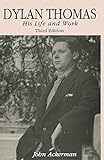
BooksSeptember 1996 Shorter notice Review of Dylan Thomas: His Life & Work by John Ackerman John Ackerman wants to dispel two pervasive myths about Dylan Thomas (1914 1953): that Thomas was the colorful drunk and rhapsodizing lyrist portrayed in works like J. M. Brinnins memoir Dylan Thomas in America, and that Thomas, having dissipated the inspiration of his angelic youth, spent his last years as a sort of traveling clown, besotted by drink and poetically impotent. In place of these myths, Ackerman presents Thomas the working-class Welsh bard, relatively sober and productive to the end. Now that Thomas is accepted as a great twentieth-century poet and prose writer, the tides of sensationalism and denigration largely ebbed away, we can trace his professional commitment both in films and broadcasting that contributed to his later development, in poetry and prose, and also the ordinariness of his life. Whether Thomas merits inclusion in the pantheon of twentieth-century greats remains open to question. What seems certain is that Ackermans gormless attempt at a critical life will convince no one of the poets greatness; it may, however, gain inclusion in the pantheon of truly bad books. The life, in fact, receives scant treatment, whereas Ackerman labors like a mule over the poemsthough Im sure a mule could have done better. Here is the first stanza of Especially when the October wind: And the typically picayune comment by Ackerman: The punishing by frosty fingers is an original evocation of the feeling of the wind blowing through the hair. The sun is referred to as crabbing since it casts a crab-like shadow of the body (as suggested in the later image, shadow crab). In the heat of exegesis, he forgets the first line, getting the season wrong: for the time of the poem is early winter. Thomass alliterative and assonantal excesses stem, we are told, from the Welsh tradition of cynghanedd, meaning harmony, and in poetry is a means of giving pattern to a line by the echoing of sounds, consonantal and vowel. A satisfactory explanation, but no excuse. Of course, the poet knew no Welsh. Ackerman, as noted, occasionally aims his penetrating insight at Thomass now legendary life. Of his childhood we learn that his mother thought him a very sensitive boy, that he was in Ackermans words a highly-imaginative, sensitive child possessing a hypersensitive nature. When not repeating himself, Ackerman contradicts himself. For instance, Thomass intense nature, enjoying all the pleasures of life, was alien to [Welsh Puritanisms] repressive doctrines; so it comes as a surprise to find that, ten pages later, He was a Puritan. In another reversal, Ackerman takes Thomas at his word when he compared himself to Arthur Rimbaud: This reasoned derangement of all the senses is, as we have seen, a characteristic of Thomass poetry: indeed he once referred to himself as the Rimbaud of Cwmdonkin Drive. As long as its convenient, Ackerman doesnt mind the myth of the debauched poet. While living, Thomas received much acclaim for his best work: Randall Jarrell thought him more original than Hart Crane. His posthumous reputation has foundered on the rocks of dissent. Such poems as Before I knocked, The force that through the green fuse drives the flower, Fern Hill, Poem in October, and two or three others are, in my opinion, still rightly esteemed for their mellifluousness, their prosodic virtuosity, and the lyrical lushness (some would say decadence) of their language. With the villanelle Do not go gentle into that good night, the poet achieved his least disputed instance of greatness. Aside from these, Thomas wrote some euphonious poems, a lot of romantic doggerel and stultifying songs, a few volumes of humorous stories (Portrait of the Artist as a Young Dog and Adventures in the Skin Trade), reminiscences of childhood (virtually his entire oeuvre could be placed under this rubric), and a handful of screenplays and radio broadcasts notable mainly for their mawkishness and constricted subject matter. Thomas never got over the quaintness of his childhood. Ackermans insipid commentary gives no sense of Thomass limits as a poet and offers a deranged assessment of his successes. He conspicuously fails to discuss Do not go gentle and flubs the rhyme scheme of Over Sir Johns Hill. Reading Fern Hill, he makes much of that poems syllabic structure, actually counting all its syllables for us, but he never analyzes the accentual pattern of the poemevincing a thorough ignorance of prosody. Thomass radio play Under Milk Wood, which Ackerman purports to admire, is summed up in a series of negations: There is no plot, no action, no development of incident . The characters remain basically the samethey come to no deeper knowledge of themselves than they possessed at the outset. Obviously, this is a description designed to make us rush out and read the play. Relying heavily and uncritically on secondary sources, Ackerman does happen upon something useful. He cites Matthew Arnold, who, in an essay on Welsh literature, adumbrates Thomass fundamental weakness as a poet: The true art, the architectonicé which shapes great works comes only after a steady, deep-searching survey, a firm conception of the facts of human life, which the Celt has not patience for. So he runs off into technic, where he employs the utmost elaboration, and attains astonishing skill; but in the contents of his poetry you have only so much interpretation of the world as the first dash of a quick, strong perception, and then sentiment, infinite sentiment, can bring you.Replete with unsupported assertions, clumsy argumentation, and a feckless inattention to detail, Ackermans book manages to do little more than explode the myth of his own competence. This article originally appeared in The New Criterion, Volume 15 September 1996, on page 143 Copyright © 2013 The New Criterion | www.newcriterion.com http://www.newcriterion.com/articles.cfm/dylanthomas-kunitz-3524
E-mail to friend
|
On Robert Ryman: New Paintings at PaceWildenstein; Elmer Bischoff: Paintings, at Salander-O'Reilly Galleries; Paul Resika: Paintings, at Salander-O'Reilly Galleries & Jeff Wall: New Work at Marian Goodman Gallery. On Leland Bell at Salander-O’Reilly Galleries, and Georg Baselitz at Pace-Wildenstein. Webcasts
Poet George Green reads from his award-winning Lord Byron's Foot
Celebration of the Life of Robert H. Bork, 1927–2012
James Panero on price gouging at the Met, with Fred Dicker |
add a comment